
Table of Contents
Geometric mean as a square side
Geometric mean as a square side
A rectangle with sides a and b has the same area as a square whose side is their geometric mean.
Show exact plotted values as a table
Geometric mean is the product-root average. It is used when values multiply, compound, or represent ratios.
The phrase sounds advanced, but the idea is simple: multiply the values, then take the root that matches how many values you have.
Formula
For n positive values:
GM = (x1 * x2 * ... * xn)^(1 / n)If there are two values, take the square root. If there are three values, take the cube root. If there are five values, take the fifth root.
Easy example with two numbers
Find the geometric mean of 4 and 16.
GM = (4 * 16)^(1 / 2)
GM = 64^(1 / 2)
GM = 8
The answer is 8.
Why 8 makes sense
The geometric mean of 4 and 16 answers this question:
What number could be used twice to get the same product?
4 * 16 = 64
8 * 8 = 64
So 8 is the matching middle factor.
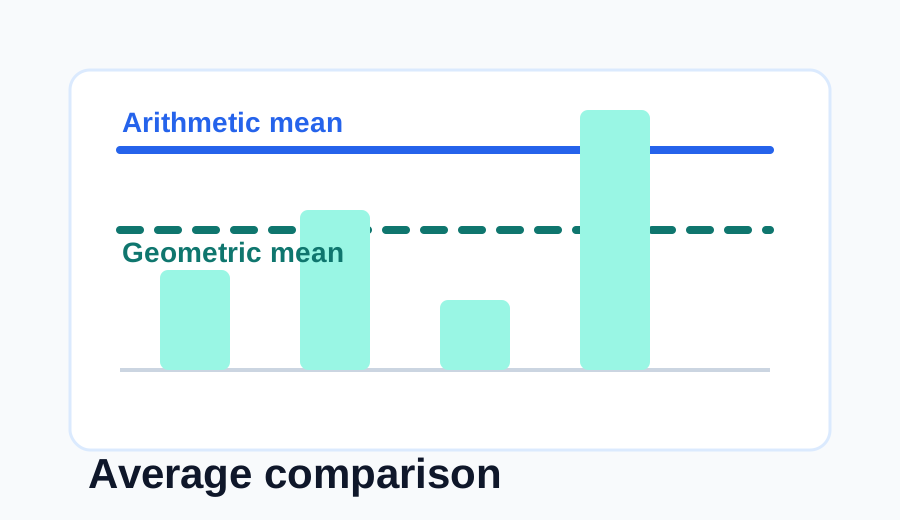
Arithmetic mean comparison
The arithmetic mean of 4 and 16 is:
(4 + 16) / 2 = 10| Average | Result | What it preserves |
|---|---|---|
| Arithmetic mean | 10 | Same sum |
| Geometric mean | 8 | Same product |
Both answers are correct, but they answer different questions.
For more detail, read Geometric Mean vs Arithmetic Mean.
When students should use geometric mean
Use geometric mean when the problem involves:
- Growth rates
- Multiplication
- Ratios
- Scale factors
- Percent changes converted to factors
- Right-triangle altitude theorem
Use arithmetic mean when the problem involves ordinary adding, such as scores or counts.
Percentage example
Suppose something grows by 20% and then falls by 20%.
Convert to factors:
| Change | Factor |
|---|---|
| +20% | 1.20 |
| -20% | 0.80 |
Geometric mean:
(1.20 * 0.80)^(1 / 2) = 0.9799The average compound change is:
0.9799 - 1 = -0.0201 = -2.01%So the average compound return is negative, even though the simple average of +20% and -20% is 0%.
Geometry connection
Geometric mean also appears in right triangles.
If an altitude from the right angle splits the hypotenuse into two segments, p and q, then:
h = sqrt(p * q)That means the altitude h is the geometric mean of the two hypotenuse segments.
Use the Altitude Theorem Calculator to see this visually.
Common mistakes
Using geometric mean with zero
Ordinary geometric mean needs positive values.
Using raw percentages
Convert percentages to factors first. A 10% increase is 1.10, not 10.
Forgetting the root
Multiplying is only the first part. You still need the nth root.
Choosing it for every average problem
Use geometric mean only when multiplication or ratios are part of the meaning.
Practice questions
| Problem | Answer |
|---|---|
| Geometric mean of 9 and 25 | 15 |
| Geometric mean of 2 and 8 | 4 |
| Geometric mean of 1.10 and 0.90 | About 0.995 |
A classroom sequence that works
A good lesson on geometric mean should move from a picture to a number, then from the number to a real use case. If students start with the formula alone, it can feel like a strange root operation. If they first see why a square with side 8 has the same area as a 4 x 16 rectangle, the formula has a job to do.
Start with two questions on the board:
What side length gives the same perimeter?
What side length gives the same area?
For the rectangle 4 x 16, the same-perimeter square has side 10, because the arithmetic mean of 4 and 16 is 10. The same-area square has side 8, because the geometric mean of 4 and 16 is 8.
This contrast is powerful. It tells students that arithmetic mean is connected to addition, while geometric mean is connected to multiplication. The numbers are not just outputs. They explain what kind of sameness is being preserved.
Board example with student prompts
Use this example slowly:
Find the geometric mean of 3 and 12.Ask students to multiply first:
3 x 12 = 36Then ask what number times itself gives 36:
sqrt(36) = 6The geometric mean is 6.
Now ask students to compare it with the arithmetic mean:
(3 + 12) / 2 = 7.5The discussion question is not “which answer is right?” Both are mathematically valid. The better question is “which answer fits the situation?” If the problem is about preserving a sum, use 7.5. If the problem is about preserving a product, use 6.
That wording helps students avoid treating the geometric mean as a special trick. It is an average with a purpose.
Mini activity: make the product stay the same
Give students a product target, such as 64, and ask them to find pairs of positive numbers that multiply to 64.
| Pair | Product | Geometric mean |
|---|---|---|
| 4 and 16 | 64 | 8 |
| 2 and 32 | 64 | 8 |
| 1 and 64 | 64 | 8 |
| 8 and 8 | 64 | 8 |
The arithmetic mean changes across the rows, but the geometric mean stays at 8 because the product stays at 64. This gives students a clear pattern they can see without memorizing a rule.
Then ask what happens when the numbers become more uneven. The pair 1 and 64 has an arithmetic mean of 32.5, but the geometric mean is still 8. That difference is a chance to explain why geometric mean is less pulled upward by one very large value when the product is the important feature.
Connecting to percentages
Once students understand the area example, move to growth factors. Percentages are often confusing because students see 10% and -10% and expect them to cancel.
Use this example:
Start with 100.
Increase by 10%.
Then decrease by 10%.
The first step gives:
100 x 1.10 = 110The second step gives:
110 x 0.90 = 99The final value is 99, not 100. The changes do not cancel because the second percentage applies to a new base. That is why geometric mean is useful for compound change.
Students should learn to convert percentages into factors:
| Change | Factor |
|---|---|
| +10% | 1.10 |
| -10% | 0.90 |
| +25% | 1.25 |
| -25% | 0.75 |
Then the geometric mean can summarize the repeated factor.
How to grade explanations
When students solve a geometric mean problem, the final number is only part of the answer. A strong explanation should include:
- The product being averaged
- The root being taken
- The meaning of the result
- Why geometric mean fits the situation
For example:
The geometric mean of 4 and 16 is 8 because 8 x 8 gives the same product as 4 x 16. It is the side length of a square with the same area as the rectangle.That answer is better than simply writing sqrt(64) = 8, because it explains what the number represents.
Calculator use in class
The Geometric Mean Calculator is useful after students understand the small examples by hand. Let students first calculate two-number examples manually, then use the calculator for longer lists such as 2, 4, 8, 16, 32.
For extension work, ask students to compare the geometric mean with the Arithmetic Mean Calculator and explain why the two answers differ. For finance examples, point them to the CAGR Calculator so they can see how the same root idea appears in annual growth.
The calculator should not replace reasoning. It should make larger examples easier once the reasoning is already clear.
Student misconception table
| Misconception | Better explanation |
|---|---|
| Geometric mean is always the “better” average | It is better only when products, ratios, or compound change matter |
| Percent gains and losses cancel automatically | They apply to changing bases, so the order and product matter |
| The geometric mean of 4 and 16 is the midpoint | The midpoint is arithmetic; geometric mean preserves the product |
| Zero can be included normally | Ordinary geometric mean needs positive values |
| The answer has no unit | The unit depends on the input: length, factor, ratio, or index relative |
Use this table as a quick review before homework or quizzes.
Differentiated practice ideas
For students who are just learning the concept, use two-number examples with perfect-square products: 4 and 9, 4 and 16, 9 and 25, or 16 and 36. These let students focus on the meaning before the arithmetic becomes distracting.
For students who are ready for more, use non-perfect products such as 5 and 20 or 3 and 15. Ask them to estimate first, then use a calculator. The estimate should fall between the two values and should be closer to the smaller value than the arithmetic mean is.
For advanced students, use three or four factors:
Find the geometric mean of 2, 4, and 16.The product is 128, and the cube root is about 5.04. This is a useful moment to explain why the root changes with the number of values.
Exit ticket questions
End the lesson with short written answers:
- What does arithmetic mean preserve?
- What does geometric mean preserve?
- Why does +20% followed by -20% not average to no change?
- What input problem would make geometric mean invalid?
- When would you choose the calculator instead of hand calculation?
These questions show whether students understand the idea, not only the button sequence.
Short answer students can remember
Use this sentence as a final anchor:
Arithmetic mean finds the equal addend. Geometric mean finds the equal factor.That sentence is simple enough for a notebook margin, but it carries the whole lesson. If students can explain the difference between an equal addend and an equal factor, they are ready to choose the right average in unfamiliar problems.
FAQ
Why is it called geometric mean?
One reason is that it appears in geometry. For two values, it can represent the side of a square with the same area as a rectangle.
Can the geometric mean be bigger than the arithmetic mean?
For positive values, no. It is always less than or equal to the arithmetic mean.
What is the easiest way to remember it?
Arithmetic mean preserves a sum. Geometric mean preserves a product.
Related calculators
Use the Geometric Mean Calculator to practice product-root examples. For the visual geometry connection, see the Altitude Theorem Calculator. If you are choosing between average types, use Which Average Should I Use?.